
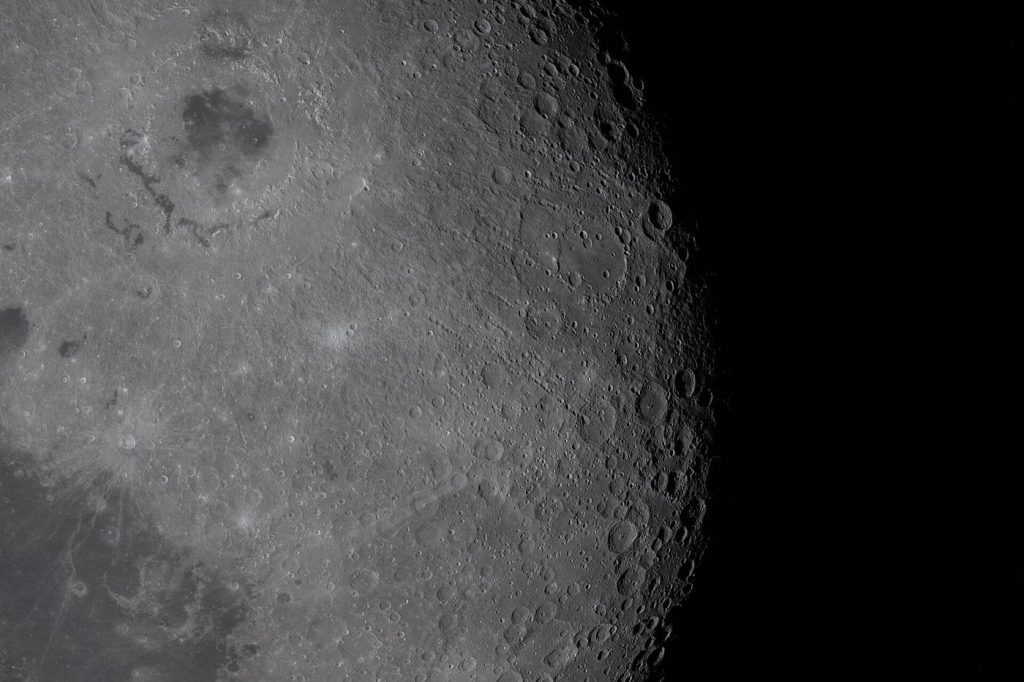
The Moon has no atmosphere and no weather as we know it, yet its surface is far from unchanging, and the culprit is a constant stream of charged particles flowing outward from the Sun. This solar wind strikes lunar soil directly, grain by grain, and over immense spans of time it alters both the colour and the chemistry of the top layer. Laboratory teams examining returned lunar samples under powerful microscopes can now see the damage in detail: tiny rims on individual grains, enriched with microscopic beads of iron formed as the particle impacts melt and vapourise mineral surfaces. Those iron beads are the main reason old lunar soil looks darker than fresh material thrown up by a recent crater impact, a contrast visible even in photographs taken from orbit. Scientists call the whole process space weathering, and understanding it matters well beyond the Moon. The same darkening affects asteroids and other airless bodies, which means telescopes can misjudge what those objects are made of unless researchers correct for the weathering effect when interpreting the light reflected from their surfaces.
What the Evidence Shows
To untangle the process, researchers have been firing beams of charged particles at simulated lunar soil in vacuum chambers, reproducing in days what the solar wind does over thousands of years. The experiments confirm that the darkening depends strongly on the original minerals present, so soils rich in certain iron-bearing rocks weather faster and more visibly than paler highland material. That helps explain the patchwork appearance of the lunar landscape, where ancient, heavily weathered plains sit beside brighter, younger crater rays. The work also has a practical side for future lunar bases, because weathered soil behaves differently from fresh soil when it is dug, moved or used as building material and shielding. Its fine, sharp grains cling to equipment and spacesuits, a problem reported by Apollo crews and still unsolved for long stays. Some mission planners therefore propose testing soil processing early, heating regolith to extract oxygen and water while also studying how its properties change. Reporting and analysis from sources such as NASA track the same developments, and specialists following the solar-wind-darkened lunar soil say the direction is now consistent across independent lines of evidence.
The Wider Context
Funding bodies are watching the solar-wind-darkened lunar soil closely because the work sits at the junction of basic curiosity and practical return. Grant panels increasingly ask for a path from discovery to application, while researchers push back that the most valuable uses of fundamental science are rarely the ones written into the original proposal. The tension is productive when both sides stay honest about timescales.
What Happens Next
The long view on the solar-wind-darkened lunar soil is that fields advance by accumulation rather than by single announcements. This result adds a solid, checkable piece to a structure many teams are building, and its authors have shared their data so the piece can be tested from every side. That is how the picture eventually becomes reliable enough to act on. You can follow related developments in our coverage of science.
It is also worth remembering how quickly the picture in this area has changed before. Positions that looked settled a few years ago have been revised as new data arrived, and the same humility is appropriate now. The strongest coverage of this subject, and the most useful advice, tends to come from sources that update their views openly when the facts move, rather than defending an earlier position long after it has stopped fitting the evidence available.
