
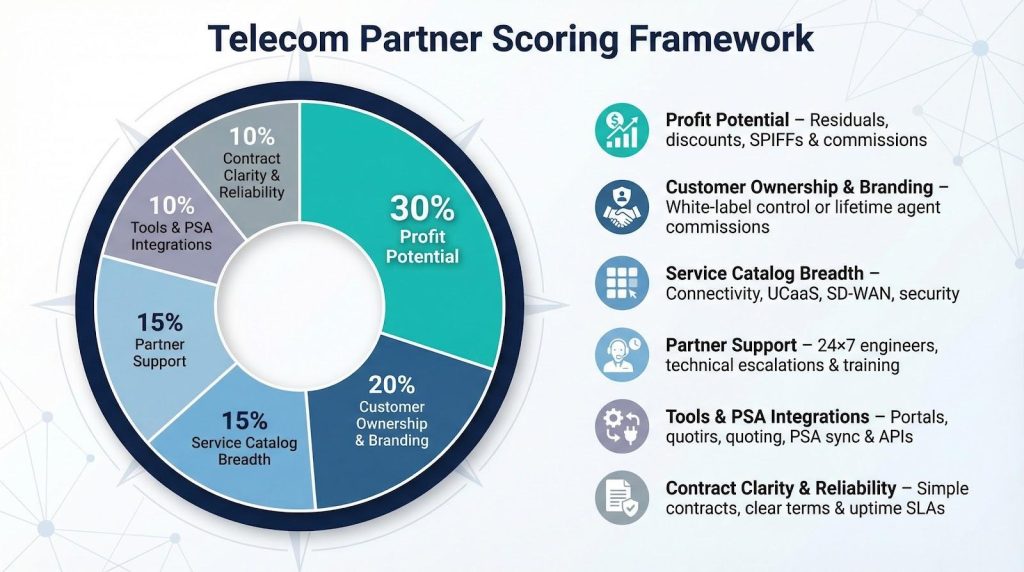
Choosing a partner program is math and real-world testing. We interviewed MSP owners, reviewed independent scorecards, and read public partner guides, then applied one weighted framework so every vendor played by the same rules.
Profit potential carries thirty percent of the score. We factored in lifetime residuals, wholesale discounts, and up-front SPIFF payouts.
Customer ownership and branding flexibility make up twenty percent. White-label control or lifetime agent commissions add equity to your business, so we rewarded programs that let you keep the relationship.
Service catalog breadth and partner support each account for fifteen percent. A wide menu of connectivity, UCaaS, and SD-WAN options matters; so does a 24 × 7 engineer who picks up when QoS nosedives during a client’s quarterly call.
Tools and PSA integrations receive ten percent. You deserve portals that quote in seconds and sync directly with ConnectWise instead of forcing manual spreadsheets.
The remaining weight covers contract clarity and platform reliability. Hidden quotas or shaky uptime cost points quickly.
Add it all up, and you get a clear numerical rank. The programs ahead win on the scoreboard, not on hype.
Telecom reseller programs at a glance
Here is a quick snapshot of how each program stacks up on the scoring factors. Use the table as a reference before we walk through every option.
| Program | Model | Recurring income | White-label? | Key services | Notable edge |
| TD Synnex | Aggregator/TSD | Carrier residuals (shared) | No | Connectivity, cloud, 5G | One contract, hundreds of carriers |
| Telarus | Master agent | 50%+ lifetime residuals | No | UCaaS, circuits, security | Deep engineering bench |
| Intermedia | Hybrid | 15% agent / 50%+ wholesale | Yes | UCaaS, CCaaS, email | Full customer ownership |
| Avant | Master agent | Tiered residuals + SPIFFs | No | UCaaS, CCaaS, SASE | Pathfinder quoting and co-marketing |
| RingCentral | UCaaS vendor | ~15% lifetime residual | No | UCaaS, CCaaS | Brand sells itself |
| 8×8 | UCaaS vendor | ~22% residual + promotions | No | UCaaS, CCaaS | Higher payout than peers |
| AppDirect | Marketplace | Wholesale margin + residual | Optional | SaaS, telecom, cloud | PSA-ready marketplace |
| SkySwitch | White-label UCaaS | 50–70% gross margin | Yes | UCaaS, SMS, fax | Turnkey billing and tax engine |
| RingLogix | White-label UCaaS | 50–60% gross margin | Yes | UCaaS, SIP, Teams | Quote-to-cash automation |
| Cato Networks | SASE vendor | 20–30% margin | Co-managed | SD-WAN, security, 5G edge | Private backbone for QoS |
Figures reflect publicly posted or partner-reported ranges as of Q1 2026. Confirm final splits with each provider’s channel team.
1. TD Synnex: your one-stop shop for business connectivity
If you already buy hardware or Microsoft 365 through TD Synnex, this program feels like adding a new module rather than learning a different system. Sign the standard distributor agreement and the Stellr business connectivity portal quickly provides quotes for fiber, broadband, wireless, and SD-WAN from dozens of carriers. One log-in, one credit line, and one monthly reconciliation keep accounting simple.
Commissions follow the traditional master-agent model: carriers pay a recurring percentage and TD Synnex passes your share through. The exact split varies by supplier, but partners say the net matches what they earned with standalone agents, minus the work of maintaining extra contracts. You can even bundle circuits with hardware on a single PO, so finance issues only one check.
Support reflects the distributor’s scale. A named connectivity specialist manages carrier escalations while product managers update you on promotions. Need pre-sales design help? Telco solution engineers join the call the same day. Training lives inside CommunitySolv, giving your team short modules on quoting fiber or pitching 5G backup between tickets.
TD Synnex does not offer white-label service. Your client signs with Comcast, AT&T, or whichever carrier wins the quote. If controlling the invoice and branding matters most, move ahead to Intermedia or SkySwitch. If you want a single vendor record for laptops, Azure, and the circuit that links it all, TD Synnex is the simplest path we have found.
2. Telarus: the catalog leader with engineers on call
Telarus wins on breadth. Its line card tops three hundred suppliers and moves nearly three billion dollars in annual billings through a single portal.
That size pays off when you need options fast. Enter an address into GeoQuote and you see real-time fiber, broadband, and wireless pricing from dozens of carriers within seconds. Planning a multi-site rollout? The same tool lines up national coverage without juggling spreadsheets.
Depth alone is not enough, so Telarus backs every quote with a sizable team of solutions engineers. They design SD-WAN overlays, map contact-center call flows, and even review security architectures with you. Many MSPs compare it to adding a fractional CCIE without the payroll hit.
Commissions start near an even split and rise as your book grows. Payments land on time, though the high volume of transactions can cause the occasional mispost. Veteran partners simply audit statements each quarter and move on, accepting the trade-off for broad reach.
Polish is the main gripe. Onboarding drags for smaller shops, and current PSA integrations still rely on exports rather than true sync. If white-label control or automated ConnectWise sync is mandatory, look at AppDirect. If you want every carrier at your fingertips plus a network engineer who joins client calls, Telarus is hard to beat.
3. Intermedia: white-label margins without extra risk
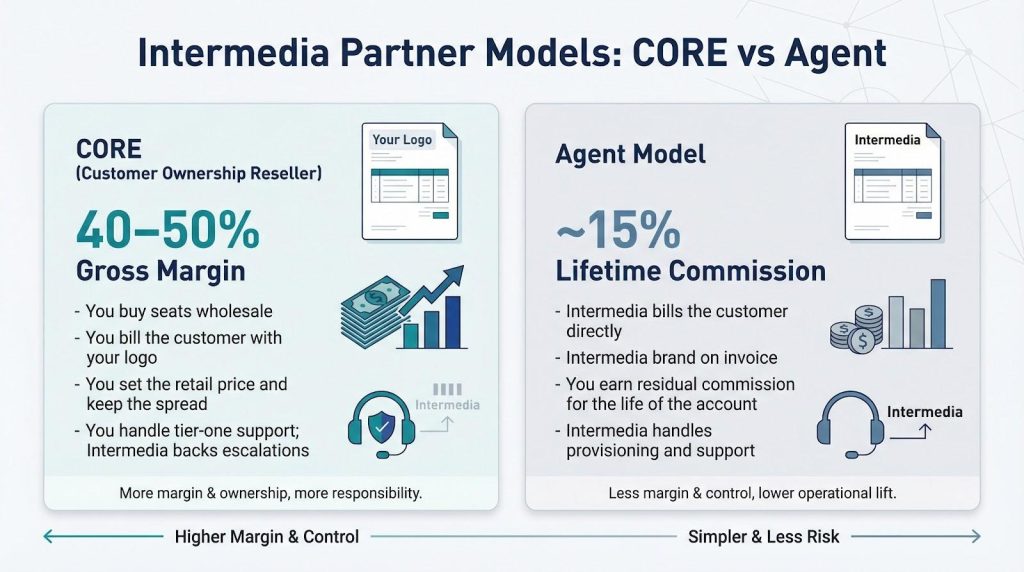
Intermedia treats partners like owners, not afterthoughts. Join its Customer Ownership Reseller (CORE) model to buy seats wholesale, set your own retail price, and issue invoices with your logo. You keep the spread, often forty to fifty percent gross margin, plus every dollar of any setup fees you charge.
Control usually brings added risk, yet Intermedia cushions the landing. You handle tier-one support while its engineers stay on standby around the clock for deeper escalations. Need to port a thousand numbers or migrate Exchange mailboxes? The onboarding team guides you step by step, then fades so the customer sees only your brand.
Prefer an easier start? Choose the agent model and Intermedia bills the client directly, sending you about fifteen percent lifetime commission. The two-track approach lets you begin simple and move to full white-label when your team is ready.
The product stack can replace several vendors: Unite UCaaS, Contact Center, business email, file sync, and secure archiving all share one platform. A single portal manages provisioning, and the built-in tax engine removes regulatory math.
Intermedia offers a focused suite you can own end to end. If you want maximum margin with minimal infrastructure, this program deserves a close look.
4. Avant: slick tooling with hands-on marketing support
Avant refers to partners as “Trusted Advisors,” and it works to earn the label. Pathfinder, its quoting platform, pulls live pricing from dozens of UCaaS, CCaaS, and security vendors, then produces polished proposals you can send the same hour a prospect asks—no spreadsheets required.
Speed is only part of the draw. Avant’s channel team joins discovery calls, builds co-branded campaigns, and even workshops LinkedIn outreach. BattleBriefing sessions package emerging tech such as SASE and AI-powered contact centers into short insights you can share with clients before rivals catch up.
Commissions follow the master-agent norm: roughly a fifty-fifty split that grows with your monthly recurring revenue. SPIFFs on UCaaS and CCaaS deals appear frequently. You cannot white-label through Avant, and current PSA links rely on exports, so operations-focused teams may be wary. Still, for MSPs who advise first and quote fast, the combination of Pathfinder and marketing support is hard to match.
Bottom line: choose Avant when you want a modern sales engine and a vendor list focused on cloud communications rather than the entire telecom universe. It feels like a marketing department without adding headcount.
5. RingCentral: the safe-bet UCaaS brand your clients already know
When a prospect asks for “something like RingCentral,” the sale almost completes itself. Gartner keeps the platform in its Leaders quadrant year after year, so credibility arrives with the first mention.
The partner motion is purely agent. Register the deal, let RingCentral’s onboarding team handle provisioning and support, and collect roughly fifteen percent residual income for the life of the account along with periodic sales incentives. Your technicians never touch tax tables or two a.m. tickets, so they stay focused on core MSP work.
Ease continues in the portal. Deal registration, quote generation, and tracking all sit in a streamlined web interface. Need help? A dedicated channel manager will co-sell, demo, and escalate issues directly to product teams.
Trade-offs are straightforward. You cannot white-label, and fifteen percent feels slim compared with white-label margins. Yet the hands-off model removes carrier headaches and leverages a household name your sales team can present with confidence. For many MSPs, that reliability outweighs the smaller slice of revenue.
If you need a voice service that practically closes itself, start here, then layer managed network or security services on top to grow the overall deal.
6. 8×8: bigger residuals for MSPs who need more than phones
If RingCentral is the household name, 8×8 is the power user’s alternative. Partners report residual payments near twenty-two percent, roughly fifty percent higher than a typical RingCentral deal, plus recurring sales incentives that can multiply first-month MRR. Higher payout is the headline.
The product story matches the economics. 8×8 runs a single architecture for UCaaS and an enterprise-grade contact center, so you sell one license stack instead of pairing voice with a third-party CCaaS later. That matters when clients outgrow basic phone queues.
Support follows the agent model: 8×8 provisions, bills, and handles every ticket. Your lift stays limited to pre-sales consult and light network prep. Some partners say the admin portal feels less polished than RingCentral’s, but the channel team compensates by joining demos and tailoring quotes for complex call-flow needs.
Shortcomings are familiar. No white-label option exists, and you ride 8×8’s product roadmap. Yet if revenue goals are climbing or you serve call-center-heavy verticals such as healthcare or logistics, the richer commission stack can fund serious service upgrades on your side.
Offer 8×8 when a client needs both phones and a full contact center, or when you simply want your recurring income to hit a little harder each month.
7. AppDirect: a PSA-ready marketplace for bundling cloud, telecom, and security
Most technology service distributors add MSP features to a telecom core. AppDirect takes the opposite route. It started as a cloud-commerce platform, then absorbed master agents and billing tools to create one marketplace where you can place Microsoft 365 seats, SIP trunks, and MDR subscriptions on the same invoice.
The appeal is operational clarity. Add a service and AppDirect syncs quantities and pricing straight into ConnectWise or Autotask, ending manual data entry for your finance team. Need a customer store? Launch a white-label portal in an afternoon and let clients provision add-on licenses on their own schedule.
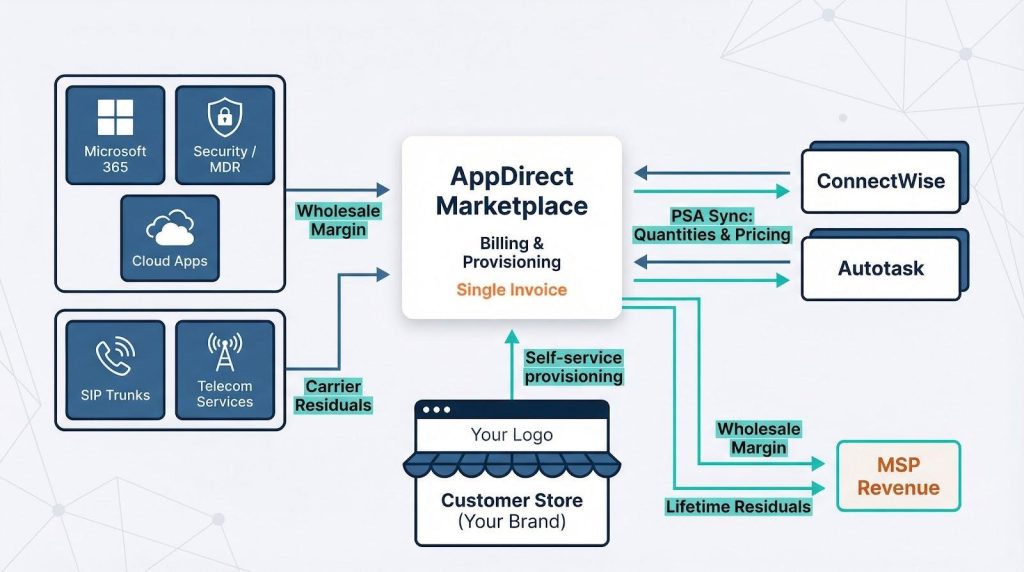
Revenue arrives two ways. For SaaS and wholesale telecom items, you set the retail price and keep the margin. For traditional carrier circuits, AppDirect acts as a master agent and pays lifetime residuals. The hybrid model lets you earn higher profit on products you control while still accessing carrier catalogs when needed.
Support reflects the dual structure. AppDirect’s service desk maintains the marketplace infrastructure, while underlying vendors handle product tickets. A partner concierge steps in when issues cross boundaries, saving you from marathon call trees.
AppDirect’s breadth can feel overwhelming at first, and you may give up a small slice of margin compared with signing each vendor direct. Yet for MSPs who value efficiency and a single billing source of truth, the marketplace model offers a compelling path.
8. SkySwitch: build your own phone company at high margin
SkySwitch gives you a full white-label UCaaS platform and stays out of sight. Everything the customer touches—the portal, invoices, and mobile app—carries your logo. Partners often clear fifty to seventy percent gross margin on voice services after paying SkySwitch’s wholesale rates.
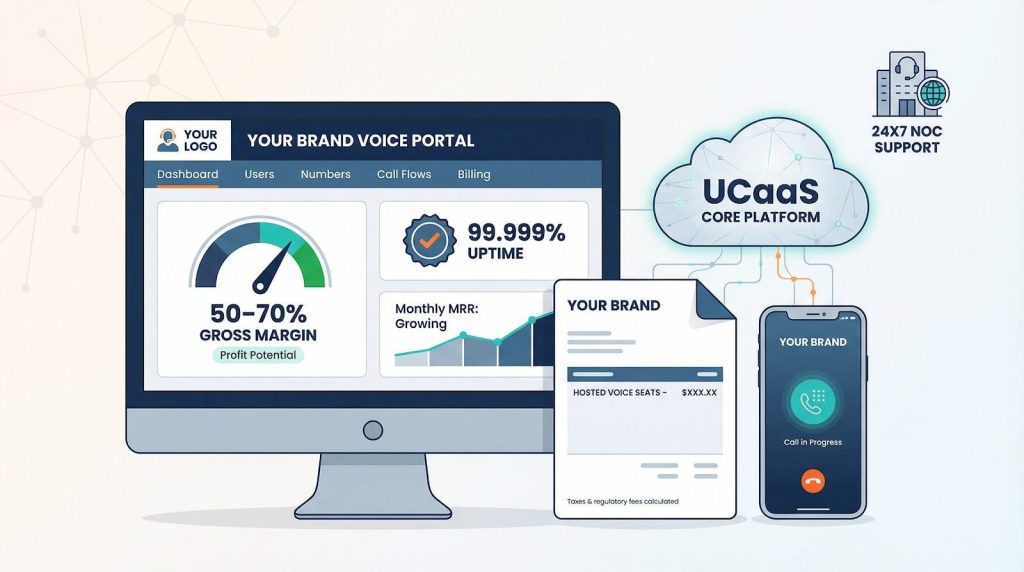
Profit alone will not sell phones; reliability will. SkySwitch runs a multi-data-center NetSapiens core with 99.999 percent uptime and a 24 × 7 network operations center that answers partner tickets within minutes. When a handset drops registration at two a.m., your team can escalate straight to switch engineers while the client still sees your brand handling the issue.
Getting started is quick. After a short portal training and a small prepaid balance, you can activate numbers the same day. The billing engine calculates taxes and regulatory fees automatically, protecting you from United States Universal Service Fund audits. Add the annual Vectors conference and a library of re-brandable collateral, and you have a full go-to-market kit without hiring a telecom product manager.
The trade-off is commitment. You serve as the first line of defense when call quality tanks, and there is a learning curve to soft-switch administration. If your culture supports that ownership, SkySwitch can turn telecom into a high-margin revenue stream that scales with every seat you add.
9. RingLogix: quote-to-cash speed with white-label profit
RingLogix feels like SkySwitch’s nimble, automation-focused cousin. Open the portal, build a branded quote, email it to a prospect, and spin up the customer’s PBX the moment they e-sign—all without leaving the dashboard. The streamlined flow removes hours from each sale and eliminates copy-paste errors that erode margin.
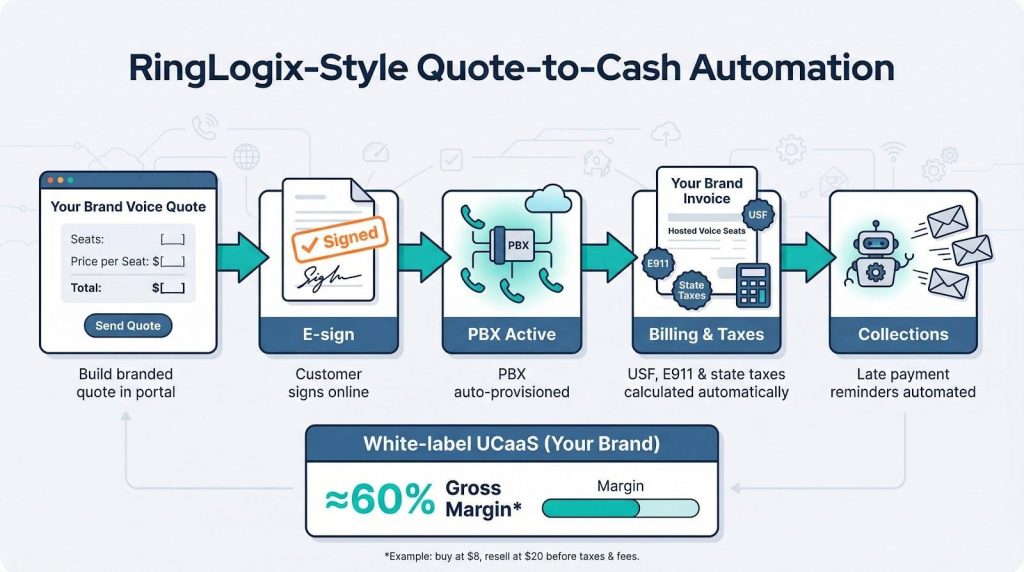
Margins are strong. Buy a seat for about eight dollars wholesale, resell at twenty, and pocket roughly sixty percent before taxes and payment fees. The platform’s billing engine calculates USF, E911, and state taxes automatically, then follows up with late payers so you do not have to.
Support matches the white-label model. You own tier one, and RingLogix covers deeper issues around the clock. Need to debug a failing SIP trunk at midnight? Their NOC answers while your client still sees your brand managing the rescue.
Feature updates arrive quickly. Teams Direct Routing, SMS, and a lightweight call-center module launched in the last year, with video meetings expected soon. For MSPs who like to tinker, RingLogix’s open APIs enable custom integrations or bundling voice into proprietary apps.
The catch is commitment. You must learn soft-switch basics and handle the first wave of “my phone will not ring” tickets. If that suits your culture, RingLogix can convert telecom into a high-margin, low-touch revenue engine that scales with every automated quote.
10. Cato Networks: ready-made SASE that erases jitter and bolsters security
Most MSPs know the scene: two bargain broadband links, a budget router, and a CEO asking why Zoom calls crackle. Cato fixes that by moving traffic from the public internet to its private, SLA-protected backbone the moment a packet leaves the site. Voice, applications, and 5G failover share the same optimized path, so latency spikes disappear.
Cato is not just a fast highway. Firewall, intrusion prevention, and secure web gateway functions live inside the cloud fabric, letting you retire on-prem appliances and apply uniform policies across every branch and remote user. One portal shows network performance and security events together, simplifying operations for both NOC and SOC teams.
The partner program follows a reseller model. You purchase service at roughly a twenty to thirty percent discount, add your managed fee, and invoice the client. Multi-year contracts stabilize revenue and improve cash-flow forecasts.
Training runs deep. Expect design workshops, certifications, and joint scoping calls before launch, followed by round-the-clock tier-three support. Sales cycles run longer than a quick VoIP deal and pricing sits at the premium end, yet when a multi-site client needs stable quality of service and zero-trust security quickly, Cato delivers both without stitching multiple vendors together.
Position Cato for customers who are done apologizing for jitter or juggling half a dozen point solutions. They gain a faster, safer network, and you secure stickier contracts plus higher-value recurring income.
Conclusion
Telecom reseller programs give MSPs multiple avenues to boost recurring revenue—from white-label UCaaS platforms to master agents with deep carrier catalogs. Use the ranking framework and snapshots above to balance margin, control, and support as you choose the partners that best fit your growth goals.