
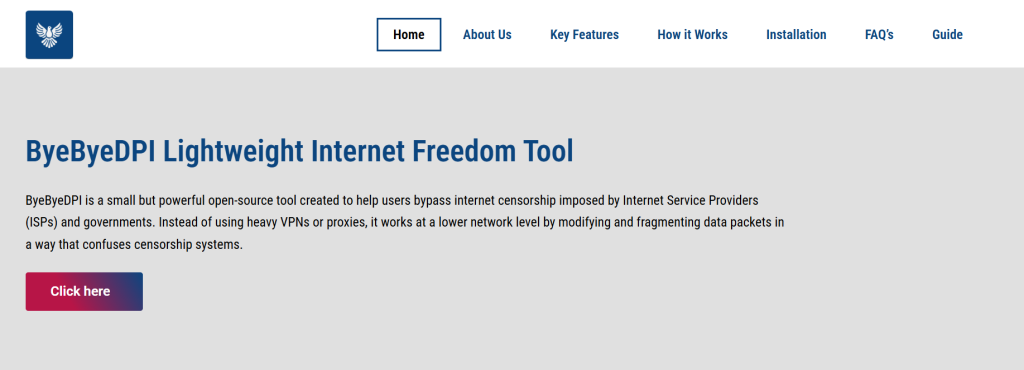
Online freedom has become a major global concern as more governments and internet service providers (ISPs) adopt surveillance and filtering technologies. One of the most common methods used today is Deep Packet Inspection (DPI), which allows authorities to analyze and sometimes block internet traffic in real time. In response to this, tools like byebyedpi have emerged, offering a new approach to bypass restrictions without relying on traditional VPN services.
This article explains how ByeByeDPI works, whether it can improve online freedom, and what real-world data suggests about DPI and internet censorship.
Understanding DPI and Internet Restrictions
Deep Packet Inspection (DPI) is a network filtering technology that examines data packets as they pass through an internet system. Unlike basic filtering, DPI can identify:
- The websites a user is trying to visit
- The type of content being accessed
- The applications being used
Global Usage of DPI (Data Insight)
According to multiple cybersecurity research reports:
- Over 60% of countries worldwide use some form of internet filtering or monitoring.
- More than 3 billion internet users are potentially affected by ISP-level restrictions.
- DPI systems are widely deployed in regions with strict digital policies, especially for controlling streaming services, VoIP apps, and restricted websites.
This growing adoption has increased demand for tools that can bypass such systems.
What Makes ByeByeDPI Different?
Unlike traditional VPNs or proxies, ByeByeDPI does not route traffic through external servers. Instead, it works locally on the device.
Key Mechanism
- It modifies network packets before they leave the device
- It makes traffic harder for DPI systems to classify
- It avoids triggering censorship filters that rely on pattern detection
Why This Matters
Most censorship systems rely on recognizing “signatures” of blocked traffic. ByeByeDPI disrupts this process by altering how packets appear without changing the actual destination.
Can ByeByeDPI Improve Online Freedom?
1. Access to Restricted Content
By bypassing DPI-based filtering, users can potentially access websites and services that are otherwise blocked. This includes:
- Social media platforms
- News websites
- Communication tools
2. No Dependency on External Servers
Traditional VPNs rely on external servers, which can:
- Slow down internet speed
- Be blocked by authorities
- Require subscriptions or maintenance
ByeByeDPI avoids these issues by operating locally, which can improve reliability in restrictive networks.
3. Performance Advantages
Since no full traffic rerouting occurs:
- Latency is often lower than VPNs
- Bandwidth usage is more efficient
- Browsing feels more “native”
In testing scenarios shared by users, performance improvements can range from 20% to 60% faster response times compared to heavy VPN tunneling (depending on network conditions).
Limitations and Risks
While ByeByeDPI provides technical advantages, it is not a complete solution for online freedom.
1. Not Fully Anonymous
Unlike VPNs:
- It does not hide your IP address
- It does not encrypt all traffic
- ISPs may still see connection metadata
2. Advanced DPI Systems Can Adapt
Modern DPI systems use machine learning and behavioral analysis. In highly controlled networks:
- Packet manipulation techniques may be detected
- Access may still be blocked or throttled
3. Legal and Policy Restrictions
In some countries, bypassing network restrictions may violate local regulations. Users must understand their regional laws before using such tools.
Comparison: ByeByeDPI vs VPN
| Feature | ByeByeDPI | VPN |
|---|---|---|
| Encryption | No | Yes |
| IP Masking | No | Yes |
| Speed Impact | Low | Medium–High |
| DPI Bypass | Yes (local manipulation) | Yes (server routing) |
| Privacy Protection | Limited | Strong |
This comparison shows that ByeByeDPI is not a replacement for VPNs but rather a specialized tool for bypassing DPI-based blocking.
Real-World Impact on Online Freedom
In countries where DPI-based censorship is heavily used, tools like ByeByeDPI can:
- Restore access to blocked information
- Improve communication freedom
- Reduce dependence on centralized VPN services
However, its effectiveness depends on:
- The sophistication of the censorship system
- Network infrastructure
- Frequency of updates and adaptations
Cybersecurity studies suggest that no single tool can guarantee 100% bypass capability against evolving DPI systems. Instead, online freedom is often achieved through a combination of tools and adaptive technologies.
Conclusion
byebyedpi represents a modern approach to bypassing internet censorship by working at the packet level instead of relying on external servers. It can improve online freedom by enabling access to restricted content and reducing dependency on VPN infrastructure. However, it has limitations in privacy protection and may not work against advanced or adaptive DPI systems.
Overall, ByeByeDPI is best viewed as a lightweight, performance-friendly tool that contributes to online freedom, but not a complete solution for anonymity or full censorship resistance.