
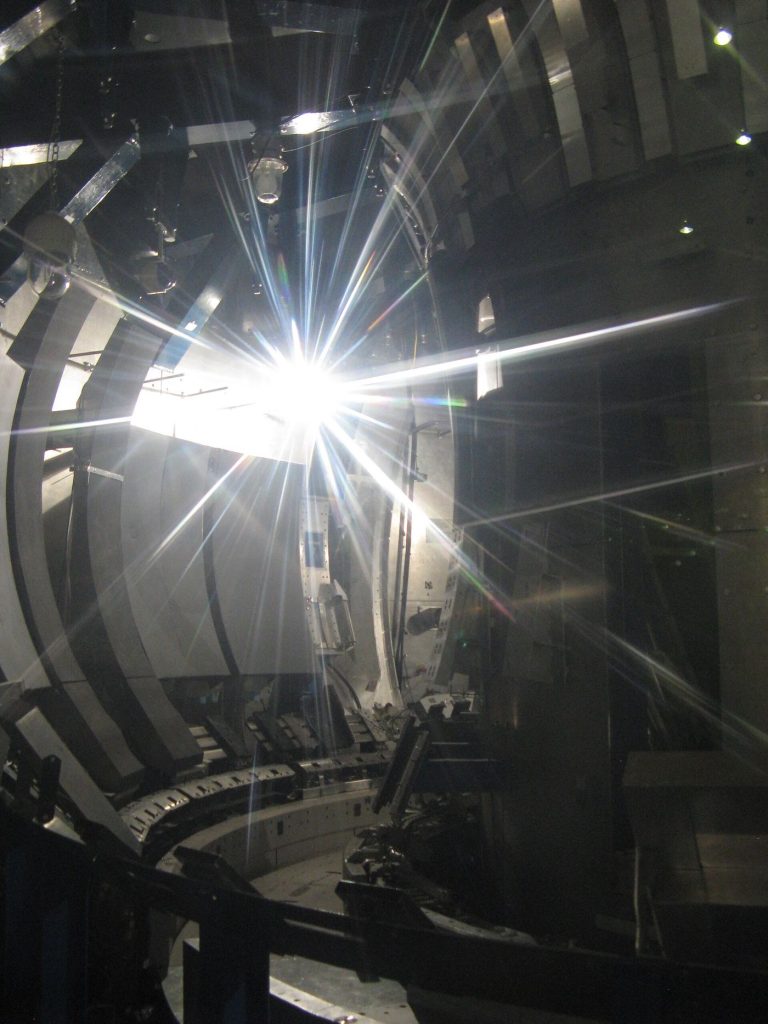
Europe’s largest fusion machine ended its life with a world record. In its final experiments in October 2023, the Joint European Torus, known as JET, in Culham, England, produced 69.26 megajoules of fusion energy in a single pulse lasting about five seconds, using just 0.21 milligrams of fuel. The result, announced in February 2024, beat JET’s own previous record of 59 megajoules set in 2021. JET was a tokamak, a doughnut-shaped chamber in which powerful magnetic fields hold plasma heated to around 100 million degrees Celsius, hot enough for hydrogen atoms to fuse and release energy. It was the only machine in the world running on the same deuterium-tritium fuel mix that future fusion power plants will use, and it operated for 40 years, completing 105,842 pulses before shutting down at the end of 2023.
What the Evidence Shows
The record is a milestone, not a power plant. JET consumed far more energy heating its plasma than the fusion reactions produced, so it never achieved a net energy gain, and its purpose was science rather than electricity. But the achievement matters because the experiments validated operating scenarios for ITER, the much larger international tokamak being built in southern France, which is not expected to run deuterium-tritium experiments until the 2030s. Private fusion companies have taken note too, raising billions of dollars to build smaller, faster machines. Fusion remains the hardest energy challenge in science, but JET’s farewell showed that the physics is understood and the engineering works. The next step is a machine that produces more energy than it consumes, and then one that does it cheaply enough to sell. Reporting and analysis from sources such as NASA track the same developments, and specialists following JET fusion energy record say the direction is now consistent across independent lines of evidence.
The Wider Context
Funding bodies are watching JET fusion energy record closely because the work sits at the junction of basic curiosity and practical return. Grant panels increasingly ask for a path from discovery to application, while researchers push back that the most valuable uses of fundamental science are rarely the ones written into the original proposal. The tension is productive when both sides stay honest about timescales.
What Happens Next
The long view on JET fusion energy record is that fields advance by accumulation rather than by single announcements. This result adds a solid, checkable piece to a structure many teams are building, and its authors have shared their data so the piece can be tested from every side. That is how the picture eventually becomes reliable enough to act on. You can follow related developments in our coverage of science.
It is also worth remembering how quickly the picture in this area has changed before. Positions that looked settled a few years ago have been revised as new data arrived, and the same humility is appropriate now. The strongest coverage of this subject, and the most useful advice, tends to come from sources that update their views openly when the facts move, rather than defending an earlier position long after it has stopped fitting the evidence available.
