
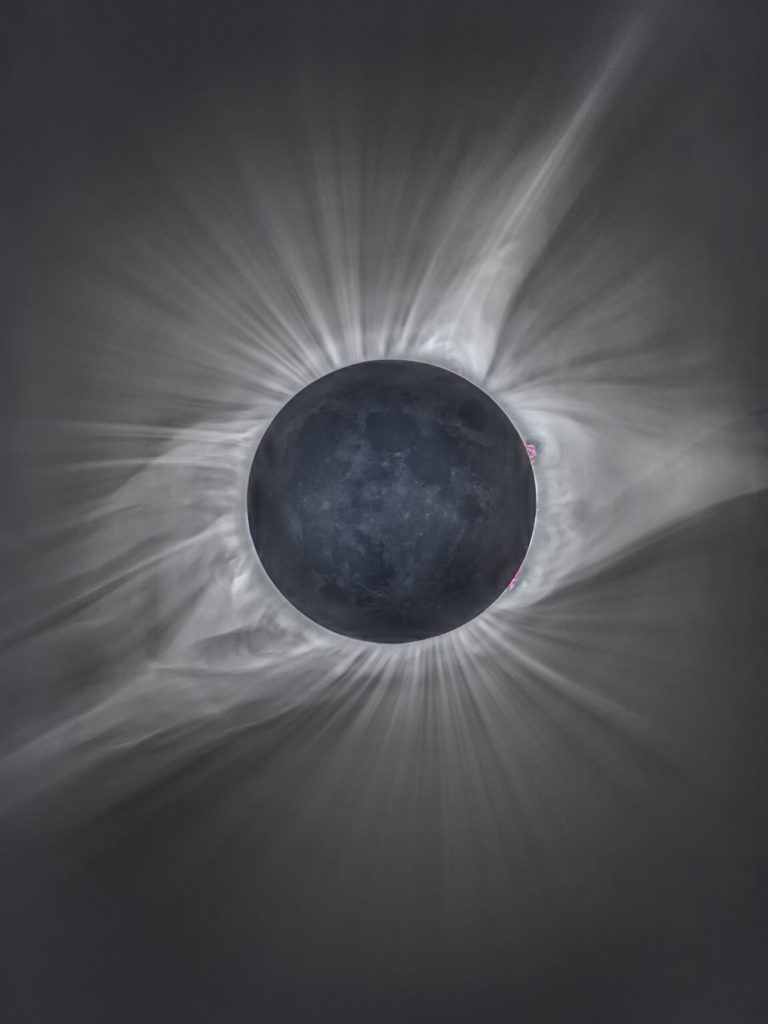
For a few precious minutes during a total solar eclipse, day turns to twilight, birds fall silent and the Sun’s blazing disc is covered by the Moon, revealing the corona, a pearly halo of hot gas that is normally drowned out by the Sun’s glare. The corona stretches millions of kilometres into space and is far hotter than the Sun’s surface, reaching temperatures above a million degrees, a puzzle that has baffled scientists for decades. During totality, researchers can study its delicate streamers and loops, watch material flowing outward to become the solar wind and test instruments that will later fly on space missions. The Moon’s shadow races across the Earth at thousands of kilometres an hour, so totality lasts only a few minutes at any one place, and astronomers plan for years to be under the path. For everyone watching, the sight is unforgettable. Special eclipse glasses are essential for watching safely, since looking directly at the Sun can damage the eyes in seconds.
What the Evidence Shows
Eclipses have taught science some of its most important lessons. During the eclipse of 1919, measurements of starlight bending near the Sun confirmed Einstein’s theory of general relativity, and helium was first detected in the Sun’s spectrum during an eclipse before it was found on Earth. Modern eclipse expeditions carry sophisticated cameras and spectrometers, capturing data that space telescopes cannot easily obtain because the Moon blocks the Sun so cleanly. The same expeditions also study how the sudden darkness affects the atmosphere and wildlife, from temperature drops to confused animal behaviour. Because a total eclipse is visible from any given place only once in several centuries, many enthusiasts travel the world chasing them. Each one offers a brief window into the Sun’s outer atmosphere and a reminder of the precise geometry that makes it possible. Reporting and analysis from sources such as NASA track the same developments, and specialists following the solar eclipses revealing the sun’s hidden corona say the direction is now consistent across independent lines of evidence.
The Wider Context
Funding bodies are watching the solar eclipses revealing the sun’s hidden corona closely because the work sits at the junction of basic curiosity and practical return. Grant panels increasingly ask for a path from discovery to application, while researchers push back that the most valuable uses of fundamental science are rarely the ones written into the original proposal. The tension is productive when both sides stay honest about timescales.
What Happens Next
The long view on the solar eclipses revealing the sun’s hidden corona is that fields advance by accumulation rather than by single announcements. This result adds a solid, checkable piece to a structure many teams are building, and its authors have shared their data so the piece can be tested from every side. That is how the picture eventually becomes reliable enough to act on. You can follow related developments in our coverage of science.
It is also worth remembering how quickly the picture in this area has changed before. Positions that looked settled a few years ago have been revised as new data arrived, and the same humility is appropriate now. The strongest coverage of this subject, and the most useful advice, tends to come from sources that update their views openly when the facts move, rather than defending an earlier position long after it has stopped fitting the evidence available.
